Blogs are dead. Social media is dead, or so people keep saying. I’m not convinced on either front. Writer Nicholas Cole advises us to go where the people are – and publish directly on social media. Street Photographer Eric Kim is strongly in favour of posting on your own turf – and owning your creative content! Starting from today, I’ll be posting some of my photography here (old and new). The focus will be on street photography which I’ve been dabbling in since 2022. One image a day, if possible, although this won’t a 365 photo project. I live in Manchester where it rains 4 days out of 7; which means taking a semi-decent picture every day is an impossible task.
My interest in photography, “street” photography in particular, started in 2022. Although, I have a collection of snapshots which goes back as far as 2003. To get the ball rolling, I’ll post a few of my earlier images. Many of these shots are ‘bad’ photos, at least according to my current tastes and style. But, reviewing old ‘snapshots’ is a revealing process: they show what we were drawn to instinctively at different times, our natural aesthetic interests, or just how we composed images before we knew anything about classical rules of composition.
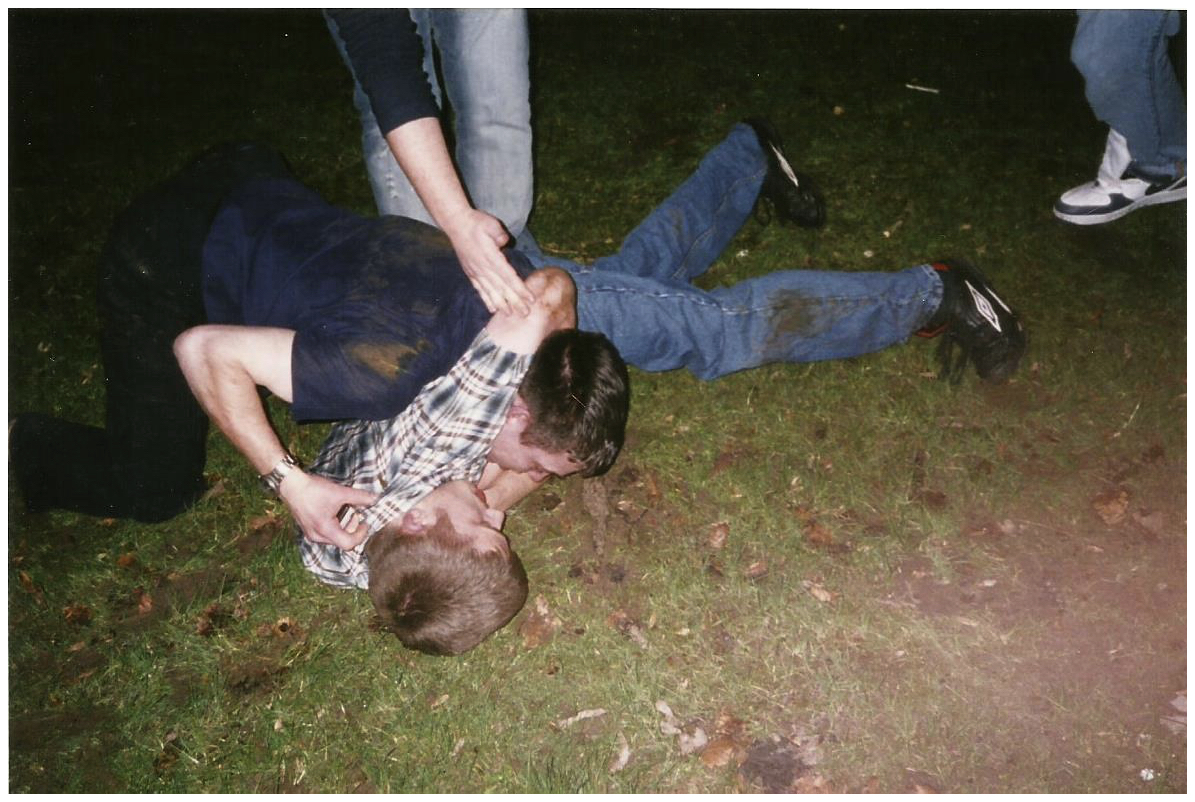
Here’s a frame from the first roll of film I ever shot:
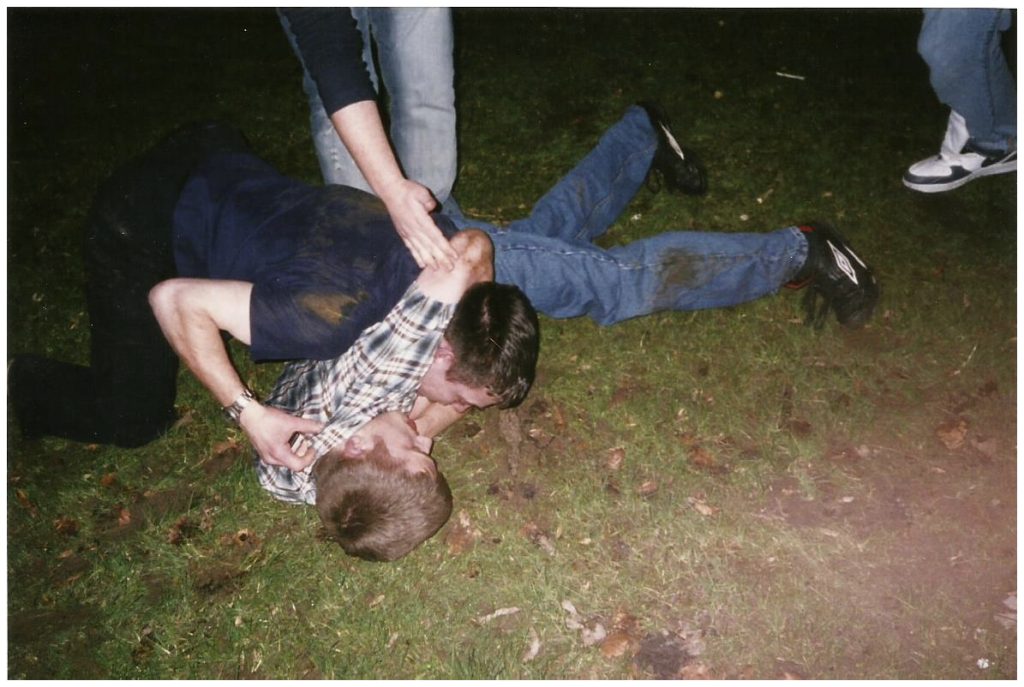
Brawl on Lancaster University Campus. 2003
Finally, in the hope of keeping this project alive for more than a month, I’ve decided on a few ‘guidelines’:
- Keep it simple: only 1 image a day. Posting more than one image a day quickly turns a photo-journal into a photo-essay. My thinking here: keep it simple, keep it going.
- No DELETING. Once an entry is posted it can’t be deleted. A problem with blogs is the ever present temptation to delete work which we view as ‘bad’ or not in keeping with our current tastes. Blog sanitisation should be viewed as a crime against creativity. My thinking: post it, leave it.
- No EDITING. As with the temptation to delete, there is also a temptation to make small tweaks: to fix a typo, edit a phrase, re-word a sentence, or just re-write completely. Every creative work, no matter how good, can be improved. Nothing we produce is ever perfect. The problem here: once we start with minor nips and tucks, it’s hard to stop. Correcting a typo leads to re-wording a bad phrase or re-writing a poor sentence. The solution, I think, is to treat all digital work like print media. No editing, not even your typos.
